
How to Choose the Right Light Bulb (Kelvin & Lumens Guide)
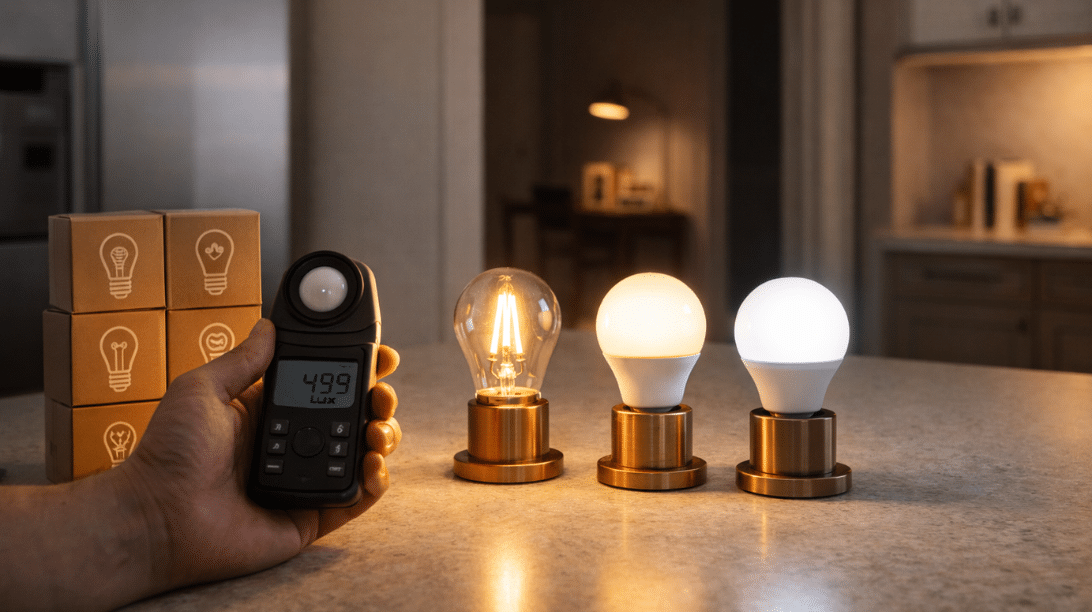
Choose bulbs by separating brightness from color. Lumens = brightness (800 lm ≈ old 60W). Kelvin = color: 2700–3000K warm and cozy, 3500–4000K clean and neutral, 5000–6500K daylight-bright for detail. Aim 1,500–3,000 lm total for living rooms, 1,000–2,000 lm for bedrooms, and bright 3500–4000K in kitchens; use 4000–5000K for prep tasks. Pick CRI 90+ for kitchens/baths, dimmable LEDs with compatible dimmers, and layer ambient, task, and accent light. Next, get exact room-by-room picks and shopping tips.
Quick Overview
- Match brightness by lumens, not watts; e.g., ~800 lm equals a 60 W incandescent.
- Pick color temperature by mood: 2700–3000K warm/cozy, 3500–4000K neutral/task, 5000–6500K daylight/detail.
- Calculate needed lumens by room: living/bedrooms 10–20 lm/ft²; kitchens 70–80 lm/ft²; brighten task zones.
- Choose CRI ≥80 for general use; CRI ≥90 in kitchens, baths, and for art for accurate colors.
- Use dimmable LEDs with compatible dimmers; consider warm-dim bulbs if you want warmer light when dimmed.
Kelvin vs Lumens: The Simple Difference
Two numbers on a bulb box do most of the heavy lifting: lumens and Kelvin. You’ll use lumens to gauge brightness and Kelvin to decide the light’s color.
Lumens (lm) quantify how much visible light a bulb emits; more lumens mean a brighter bulb. For reference, about 800 lumens equals the old 60 W incandescent. Rough ranges: 100–300 lm for soft ambient glow, 400–700 lm for general lighting, 800–1200 lm for task work.
Kelvin (K) sets the color temperature: 2700–3000K looks warm and yellow, 3500–4100K reads neutral/cool white, and 5000–6500K mimics crisp daylight. Unlike Watts, which measure energy use, lumens indicate actual brightness, and higher Kelvin values only change the light’s color rather than its output.
Remember, color isn’t brightness: a 2700K and a 5000K bulb can have identical lumens. Don’t use watts as a proxy; LEDs break that shortcut.
Balance lumens for visibility and Kelvin for mood.
A Quick Lighting Decision Guide by Room
Ready to choose bulbs room by room? First, match bulb base and shape to fixtures (A19/E26 for lamps, BR/PAR for recessed, G25 for vanities, T8/T5 for linear). Also consider that LED bulbs deliver the same brightness at lower wattage, making them more energy-efficient.
Check fixture wattage limits; pick LED equivalents that stay under the max while delivering needed lumens. Layer light: ambient, task, accent. Use higher lumens (≈400–806+) for function, lower (≈220–360) for mood. Prefer dimmable LEDs in multiuse spaces.
Living room: aim for 1,500–3,000 total lumens. Use ceiling or recessed for ambient; add floor/table lamps. Reserve 800–1100 lm for main fixtures, 400–800 lm for lamps. Add low-lumen accents.
Bedroom: target 1,000–2,000 lumens overall. Use a central light; bedside lamps 200–400 lm. Choose shaded or frosted bulbs; dimmers assist.
Kitchen/dining: guarantee bright ambient and strong task lighting; pendants should cover surfaces; add dimmers.
Bathroom/home office/utility: place bright, even vanity lighting; add ceiling lighting.
Pick a Color Temperature (CCT) for Each Room
With your fixture types and lumen targets set, the next choice is color temperature—the “warmth” or “coolness” of the light measured in Kelvin (K).
Color temperature, expressed as Correlated Color Temperature (CCT), defines how white light appears along warm to cool on the CIE diagram. Lower K looks warmer and amber; higher K looks cooler and bluish. Layering different types of lighting can also enhance the overall ambiance of the space.
Use 2700K–3000K in bedrooms, living rooms, and dining rooms to create a cozy, restful glow; 2700K is ideal for bedrooms. Sunlight shifts in color from midday around 6000K to below 3000K at sunset, so aligning indoor lighting with this natural daylight cycle can support comfort throughout the day.
Choose 2700K–3000K for cozy living spaces; 2700K is perfect for bedrooms.
Add dimmers to fine-tune mood. Choose 3000K–4000K in kitchens and bathrooms for a balanced “soft to natural white” that handles tasks while staying comfortable.
Pick 4000K–5000K for offices, reading nooks, and garages to boost clarity and focus.
Reserve 5000K+ for vanities, detail work, and commercial-style brightness.
Keep one CCT per room for a clean, unified look.
Choose Lumens by Room Size and Purpose
A smart way to size your lighting is to match lumens to the room’s area and purpose, then layer for tasks. Multiply room area by a target lumen density. In imperial, total lumens ≈ square feet × lumens/ft²; in metric, m² × lumens/m². Use lower densities for soft ambient light, higher for work. For tall ceilings above 10 feet, standard estimates may under-light the space, so plan for higher lumen density or additional fixtures to maintain the target foot-candles.
Typical targets:
- Living room ambient: 10–20 lm/ft² (100–300 lm/m²).
- Bedroom ambient: 10–20 lm/ft² (100–200 lm/m²).
- Kitchen general: 70–80 lm/ft² (300–500 lm/m²).
- Bathroom general: 200–400 lm/m².
- Study surfaces: 400–700 lm/m².
Layer lighting:
- Ambient base level.
- Task lights higher than ambient (e.g., ≈450 lm at a desk; dining table ≈30 lm/ft²).
- Accent adds on top.
Adjust for dark finishes, shaded fixtures, and high ceilings. Distribute lumens across fixtures, aim slightly high, and use dimmers. Convert total lumens to bulb count: bulbs ≈ total ÷ lumens per bulb.
Bedrooms, Living Rooms, and Halls: Bulb Picks
Start by matching bulb color and brightness to the room’s feel and function: choose warm whites (about 2700K–3000K) for bedrooms and living rooms to keep things cozy, and carry the same range into halls for continuity. A well-lit space can significantly enhance the cozy atmosphere of your living room.
Choose warm whites (2700K–3000K) for cozy bedrooms, living rooms, and halls for continuity.
In bedrooms, aim for roughly 400–800 lumens per bulb for overheads; drop to 200–400 lumens for exposed bulbs and bedside lamps to cut glare. For ultra-cozy mood lights, 2200K–2500K works well. Use dimmable LEDs and layered lighting—ambient, bedside task, and low-level accents—to wind down comfortably. To keep colors consistent and tuned to the room’s function, remember that Kelvin measures color temperature, with lower K being warmer and higher K being cooler.
In living rooms, keep ambience in the 2000K–3000K range; use about 800 lumens for general lamps, and 220–360 lumens for accents. Match Kelvin across visible fixtures, add shades or diffusers to tame glare, and prefer multiple lower-output lamps over one bright source.
Kitchens and Baths: Best Kelvin and Brightness
Cozy tones work in lounges and bedrooms, but kitchens and baths need brighter, cleaner light for clear sight lines and true color. Aim for bright white in the 3100–4500K range.
In kitchens, 3500–4000K feels neutral and balanced; push to 4000–5000K for a whiter, crisper look, especially around prep areas. For bathrooms, 3600–4200K keeps skin tones flattering while preserving detail.
Match brightness to tasks. For general kitchen lighting, target 30–40 foot-candles (square footage × 30–40 lumens).
Stove and sink zones should reach 70–80 foot-candles. Bathrooms, especially vanities, also need 70–80 foot-candles; many typical spaces total 7,000–8,000 lumens.
Use 400–700-lumen bulbs in recessed cans or ceiling fixtures, reserving 800–1200 lumens for more focused points that demand clarity.
Task Lighting for Desks, Counters, and Benches
Sometimes the right bulb is the one that puts light exactly where you need it. For desk work, aim 500–1,000 lumens per task lamp, around 500 lumens on the page for reading. Choose neutral to cool-white light (about 3500–5000K) to sharpen contrast.
Aim 500–1,000 lumens per desk lamp; ~500 on the page. Choose 3500–5000K for crisp contrast.
Place the lamp beside and slightly behind your reading shoulder—left side if you’re right-handed—to avoid hand shadows. Keep it angled away from monitors to prevent glare, and use dimming to balance screen brightness. Pair a desk lamp with ambient light to soften contrast.
On counters, use under-cabinet strips or linear LEDs delivering roughly 500–1,000 lumens per run. Mount near the cabinet’s front edge for uniform coverage; pick CRI 90+ for color-critical tasks.
At benches, use multiple fixtures totaling 1,000+ lumens. Space linear lights evenly, ~18–24 inches from the wall to avoid shadows.
Warm White (2700–3000K): Where It Works Best
Warm white (2700–3000K) is your go‑to for creating inviting, low‑stress spaces that feel like classic incandescent light.
Use it in living and family rooms to set a cozy, relaxing mood for conversation and TV; its amber tone softens glare on screens.
Make it your pick for ambient fixtures, floor lamps, and sconces in seating zones.
In bedrooms and reading nooks, 2700K feels calm and intimate, limits blue‑rich exposure in the evening, and pairs well with dimmers.
Choose it for bedside lamps, pendants, and wall lights to get comfortable, non‑clinical reading light.
For dining rooms, cafés, lounges, spas, and bars, it flatters skin tones and food, encouraging longer stays.
In entries and outdoors, it creates a welcoming glow, reduces harsh contrast, and suits paths, porches, and landscape accents.
Neutral White (3500–4000K): Where It Shines
Neutral white (3500–4000K) strikes a just-right balance: it looks clean and true without the yellow cast of 2700K or the stark edge of daylight bulbs. You’ll see minimal color shift—no obvious blue, no amber haze—so surfaces and skin tones appear natural. The mood feels balanced and focused, great for staying alert without glare or harshness. With typical CRI 80–90+, colors read accurately.
Use it where clarity matters. In kitchens, it sharpens contrast on counters and food. In home offices and study areas, it supports productivity and reduces eye strain. Around 4000K in bathrooms, you get crisp grooming light. Hallways and entries feel welcoming yet purposeful.
For mixed-use living/dining rooms, it’s a versatile compromise—especially with dimmers. Commercially, 3500–4000K excels in offices, retail, workshops, and public spaces, delivering clean, neutral illumination.
Daylight Bulbs (5000–6500K): When to Use Them
Even though they can feel intense, daylight bulbs (5000–6500K) deliver bright, crisp, blue‑white light that mimics a clear, sunny day and sharpens visual detail.
Use them where clarity, contrast, and focus matter: workshops, garages, laboratories, industrial floors, kitchens, home offices, desk setups, and hobby benches. They boost alertness, help you spot fine details, and reveal true colors for makeup, cooking, crafts, art, photography, printing, textiles, and graphic work.
Pick 5000K when you want a balanced daylight effect that’s bright but less harsh—good for multipurpose areas and longer sessions.
Choose 6500K when you need maximum contrast or to match north‑facing window daylight in color‑critical studios.
Skip daylight bulbs for cozy rooms and evening unwinding. Their cool tone can feel clinical, glare in small spaces, and increase eye fatigue.
CRI, Dimmable Bulbs, and CCT Labels: What to Buy
Ready to buy bulbs but unsure what the specs mean? Start with CRI. It tells you how faithfully colors appear on a 0–100 scale versus natural light (CRI 100). Low CRI looks dull; high CRI makes food, fabrics, and skin tones pop.
Start with CRI: a 0–100 score for true-to-life color under your lights.
It’s independent of Kelvin, so two 3000K bulbs can render color very differently. For homes, choose CRI ≥ 80 minimum; use CRI ≥ 90 for kitchens, baths, closets, makeup, and art.
If you need dimming, the box must say “dimmable.” Pair LED bulbs with compatible, LED‑rated dimmers to avoid flicker and short dimming ranges (many only dim to 10–20%).
Standard LEDs hold CCT while dimming; “warm‑dim” versions get warmer.
Check CCT labels: 2700–3000K Soft/Warm White, 3500–4100K Cool/Bright White, 5000–6500K Daylight.
Shopping Lists by Room: Kelvin and Lumens
Before you add bulbs to your cart, match each room’s Kelvin (color) and lumens (brightness) to how you actually use the space.
- Living room: aim for 1,500–3,000 lm total at 2700–3000 K.
- Add 400–700 lm bulbs for reading zones; use 220–360 lm lamps for mood.
- Kitchen: target 5,000–10,000 lm at 3500–4100 K.
- Under‑cabinet lights: 800–1,200 lm each.
- Pendants over islands: 400–700 lm each.
- Dining room: plan 3,000–6,000 lm overall at 2700–3000 K (or 3000–4000 K for crisper).
- Center fixture over table: 2,000–3,000 lm.
- Add 100–300 lm accents.
- Bedroom: total 2,000–4,000 lm at 2700–3000 K.
- Bedside lamps: 100–300 lm (up to 800 lm for reading).
- Main fixture: 400–806 lm.
- Add 220–360 lm mood lights.
- Bathroom/home office: bathroom 4,000–6,000 lm at 3600–5000 K; vanity 400–700 lm each.
- Home office 4000–5000 K; desk lamp 800–1,200 lm.
Frequently Asked Questions
How Do Smart Bulbs Affect Circadian Rhythm and Sleep?
They influence your circadian rhythm by their spectrum, intensity, timing, and duration. Blue‑rich evening light suppresses melatonin, delays sleep, and reduces deep sleep. Use bright, blue‑enriched days and dim, blue‑depleted evenings; schedule warmer, lower‑intensity light 3 hours pre‑bed.
Can Mixed Kelvin Bulbs Be Used in One Room?
Yes—you can mix Kelvin bulbs in one room. Keep differences small (e.g., 2700K and 3000K), match high CRI, avoid mixing within one fixture, separate zones, and use warmer ambient with slightly cooler task lights for comfort and clarity.
How Does Fixture Shade Color Change Perceived Kelvin?
It changes it by filtering wavelengths. Warm/beige shades absorb blue, making bulbs feel warmer; cool/gray/black emphasize cooler tones. Translucent fabrics preserve CCT; opaque or gold-lined shades warm it; white/silver linings keep neutrality. Higher-K bulbs show stronger tint shifts.
What’s the Lifespan Difference Between LED, CFL, and Incandescent?
You’ll see LEDs last about 25,000–50,000 hours, CFLs around 8,000–10,000, and incandescents roughly 1,000. That means you’d replace ~21 incandescents or ~3 CFLs for every single LED over 25,000 hours of use.
Are There Safety or Code Rules for Bulb Enclosures and Insulation?
Yes. You must use listed luminaires per NEC/IRC, follow manufacturer instructions, and choose IC-rated recessed housings where insulation contacts. Keep non‑IC cans clear of insulation, fully enclose closet fixtures, avoid exposed screw‑base lamps, and keep splices in approved boxes.
Conclusion
You’ve got this. Remember: pick color temperature (Kelvin) for mood, lumens for brightness, and match both to the room’s size and purpose. Warm whites calm bedrooms and living rooms, neutral whites boost kitchens and work zones, and daylight helps tasks and crafts. Aim for good CRI, choose dimmable when needed, and read CCT labels carefully. Use the quick room guides to shop faster, avoid guesswork, and create comfortable, functional lighting that fits your home and lifestyle.